
Case Study: NetSuite in Manufacturing
NetSuite in Manufacturing - Turning production complexity into financial clarity
C&J project-managed a tailored multi-subsidiary, multi-currency NetSuite manufacturing implementation for a bioscience company, configuring inventory, BOM and work order modules alongside third-party integrations to deliver a fully adopted, precision-fit solution.
Client: NDA
Industry: Manufacturing
How things changed
The completed implementation provided the bioscience company with a NetSuite environment designed around the realities of its business.
Rather than operating a finance platform disconnected from manufacturing requirements, the organisation gained an ERP environment capable of supporting areas including inventory management, bills of materials and work orders alongside its wider financial requirements.
Its multi-subsidiary and multi-currency structure could also be supported within the same NetSuite environment, providing a stronger foundation as the organisation developed.
Integration with the wider systems landscape was considered as part of the implementation rather than as an afterthought, an important factor for a bioscience business where specialist laboratory systems can sit alongside the core ERP platform.
Most importantly, the system was shaped through continued collaboration with the people who actually needed to use it.
Making adoption part of the project
Technology alone does not determine whether an ERP implementation succeeds.
The people who use the system every day need to understand not only how NetSuite works, but how their own role and processes fit within the new environment.
Training was therefore an important part of the implementation. Employees were given the support they needed to use the system effectively and make proper use of the capabilities being introduced.
That emphasis on adoption also meant the implementation was not treated as something being done to the organisation. Users were involved throughout the process, creating a much stronger connection between the system being configured and the way the business actually operated.
Testing before go-live
Thorough testing and quality assurance formed another important part of the project.
Before final implementation, the organisation carried out detailed testing to confirm that NetSuite was functioning as expected and to identify issues that needed to be addressed.
For a manufacturing business, that discipline is particularly important. Problems discovered before go-live can be managed within the project; problems discovered once real operational activity is flowing through the system can quickly become far more disruptive.
Testing therefore provided an opportunity to validate the configuration, resolve issues and give the business greater confidence in the system before moving into live operation.
How we helped
Acting as NetSuite Project Manager, we worked closely with the organisation to understand its manufacturing requirements, existing processes and the way different areas of the business needed to interact with NetSuite.
That discovery work was essential.
Rather than approaching the implementation as a standard system rollout, the project focused on translating the company's specific manufacturing requirements into a practical NetSuite solution.
The implementation included key manufacturing functionality such as Inventory Management, Bills of Materials and Work Orders, giving the business the foundations required to manage important manufacturing activity within NetSuite.
We also considered the wider technology environment. NetSuite needed to integrate appropriately with other systems required by the bioscience operation,... Clear project timelines were established from the outset, supported by regular communication and structured check-ins with the business. This created opportunities to identify issues early, confirm that the developing solution continued to meet operational requirements and make decisions before problems became embedded in the implementation.
Where they were
For a bioscience company, implementing ERP presents a different level of complexity from a straightforward financial system project.
Finance remains important, but the system also needs to support the operational processes behind the business. Inventory has to be managed effectively, manufacturing structures need to be reflected accurately, work needs to be controlled through the appropriate processes and NetSuite needs to coexist with the specialist systems used elsewhere in the organisation.
Add multiple subsidiaries and currencies into that environment and the implementation becomes considerably more complex.
The challenge was therefore not simply to switch on NetSuite functionality. It was to understand how the organisation actually worked and configure the system around those practical requirements without unnecessarily overcomplicating it.
Getting that right required close involvement from the business from the outset.
NetSuite in Manufacturing
Project
Overview.
Building a Scalable NetSuite Manufacturing Platform for a Bioscience Business

The client
A growing bioscience company with manufacturing operations that needed an ERP platform capable of handling considerably more than finance alone.
The organisation operated across multiple subsidiaries and currencies, while its manufacturing environment introduced additional requirements around inventory, bills of materials, work orders and integration with specialist laboratory systems.
That meant the implementation had to do more than configure NetSuite in isolation. It needed to reflect how the business actually manufactured, managed inventory and worked across its wider technology environment.



Key Achievements & Results
The result was a successful multi-subsidiary, multi-currency NetSuite manufacturing implementation designed around the specific requirements of a bioscience organisation.
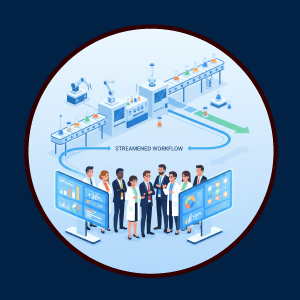
Strong project management, regular communication and close collaboration kept the implementation aligned with the business throughout. Manufacturing functionality including Inventory Management, Bills of Materials and Work Orders was configured around operational requirements, while integration with necessary specialist systems formed part of the wider solution.
Employee training and thorough testing helped ensure the organisation was prepared for the new environment rather than simply being handed a finished system at go-live.
The project demonstrated an approach that remains central to successful ERP delivery: understand the business first, configure the technology around genuine requirements, involve users throughout and test it properly before expecting people to rely on it.

Modules Used
Advanced Financials
Advanced Order Management
Advanced Inventory
Manufacturing
Demand Planning